
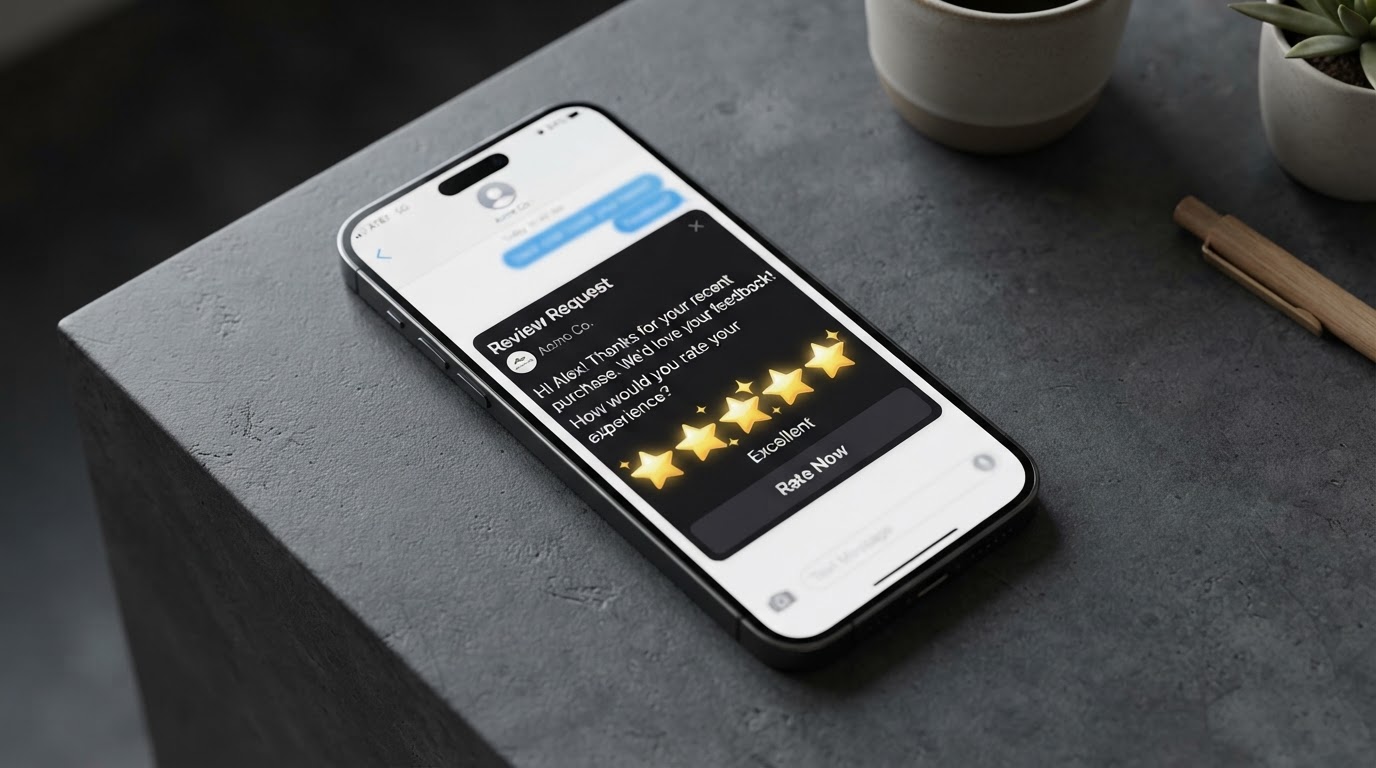
You finished the job. The customer shook your hand, told you the work looked great, and handed you a check. In that moment, they are the happiest they will ever be with your company. The work is done, the problem is solved, and you are standing right in front of them. That is the single best moment in the entire customer relationship to ask for a Google review — and almost every contractor misses it.
Instead, what usually happens is you drive off to the next job, the customer goes back to their life, and a week later you remember you meant to ask them for a review. You send a text, and either they never reply or they say they will get to it, and they never do. Meanwhile your Google profile sits there with the same handful of old reviews while your competitor picks up three new ones this week. The gap between you and them widens a little more every month, and it has nothing to do with who does better work. It has everything to do with who asks at the right time, the right way.
Let me walk you through the exact three-text sequence that turns happy customers into a steady stream of fresh five-star reviews, on autopilot, without you ever having to remember to ask.
Why Most Review Requests Fail
Before the sequence, you need to understand why the way most contractors ask for reviews does not work. There are three common mistakes, and every one of them kills the response rate.
First, they ask too late. Asking a week after the job is done is like asking someone to compliment a meal they ate last Tuesday. The emotion has faded. The customer is back to their normal life, the burst of relief they felt when the leak stopped or the roof was fixed is gone, and writing a review feels like a chore instead of a way to say thank you. Timing is everything. You want to catch them while the relief and gratitude are still fresh.
Second, they make it hard. They send the customer to a homepage and tell them to figure it out. The customer has to open a browser, search for the business, find the review button, sign in to Google, and then write the review. Every extra step is a chance for them to give up, and most people give up at step two. A good review request removes every bit of friction between the happy customer and the finished review.
Third, they ask once and give up. One text, no response, and the owner assumes the customer did not want to leave a review. In reality, the customer meant to do it and forgot. Life got in the way. A single ask misses everyone who would have reviewed if you had just nudged them one more time. The sequence below fixes all three problems at once.
Text 1: The Same-Day Ask
The first text goes out the same day the job is completed, ideally within an hour or two of you walking out the door. This is when the customer is at peak satisfaction. The job is done, the problem is gone, and you are still fresh in their mind as the person who fixed it.
The message should be short, warm, and direct. Something like: "Hey John, it's Mike with Apex Plumbing. Just wanted to say thanks for having us out today — hope the new water heater is running smooth! If you have 30 seconds, a quick Google review would mean the world to a small local business. Here's the link: [link]. Thanks either way!"
Notice what that message does. It leads with gratitude, not a demand. It names the specific job, which proves it is personal. It tells them exactly how long it will take, so thirty seconds does not feel like a big ask. And it gives them a single direct link to the review page, no searching required. One tap and they are on the review screen. Every step you remove is a review you keep.
This first text alone will get reviews from the customers who were already inclined to leave one. But the majority of happy customers will read it, mean to do it later, and forget. That is what the next two texts are for.
Text 2: The Day-Three Nudge
Three days later, a second text goes out to anyone who has not yet left a review. This is the nudge. It is not pushy, it does not guilt-trip, and it does not pretend the first text never happened. It simply reminds them, in a friendly way, that the door is still open.
A good nudge reads: "Hey John, Mike with Apex Plumbing again — no pressure at all, just wanted to bump that review link in case it got lost in the shuffle: [link]. Either way, we appreciate your business!"
This second text is where the magic happens, because it catches everyone who read the first one, meant to do it, and got distracted. It is the reminder that converts the good-intentions crowd into actual reviewers. Keep it light and always include the link again, so they do not have to scroll back to find it.
The tone matters here. You are not begging or guilt-tripping — you are just making it easy for a happy customer to do the thing they already wanted to do. The people who respond to this second text are the ones who would have reviewed you if you had asked twice in person.
Text 3: The Day-Seven Last Call
Seven days after the job, a final text goes out to anyone who still has not reviewed. This is the last call, and it works because it gives the customer permission to be honest. By now, if they have not reviewed, they are either truly too busy or they had a complaint they have not voiced. The third text opens the door to both.
The message: "Hey John, Mike with Apex Plumbing one last time. If we earned a 5-star review, it would genuinely help us reach more local families: [link]. But if anything was less than perfect, just reply here and let me know — I'd rather hear it from you directly than find out the hard way. Thanks for giving us a shot."
This text does two things at once. For the happy customer, it is one final, easy chance to leave the review. For the unhappy one, it is a private channel to tell you what went wrong before it becomes a bad public review or a lost customer forever. You would be amazed how many one-star reviews are prevented by this one message, because it gives the frustrated customer a way to complain to a human instead of to the internet. That complaint, handled well, often turns into a five-star review about how you cared enough to make it right.
Why This Beats Asking by Hand
You could do all of this manually. A few owners do, and they get more reviews than the ones who do not. But here is the reality: you are already working ten or twelve hour days, and the jobs do not stop coming because you need to send review texts. The ones that get missed are the ones from your busiest weeks — which, ironically, are the weeks you have the most happy customers and the most chances to grow your review count.
Automation does what you cannot do by hand. It fires the same-day text the moment a job closes, without you remembering. It sends the day-three nudge and the day-seven last call, without you checking a list. It runs every single week, on every single job, whether you had a slow week or a slammed one. The result is a steady, natural drip of fresh reviews — the exact pattern Google rewards. You get new reviews every single week, and your profile climbs the map pack because of it.
The Compounding Effect of Fresh Reviews
Here is why this matters beyond the numbers. Fresh reviews boost your local search ranking, because Google weighs recency heavily. A profile with a review from this week outranks one whose newest review is from last year, even if the older profile has more total stars. They also convert the customer reading them, because a homeowner scanning reviews is looking for proof you are still in business and still doing good work.
Once the sequence is running, the reviews compound. More reviews push you higher in the map pack, which means more calls, more jobs, and more happy customers to feed back into the sequence. It is a flywheel, and the three-text sequence is the spark that gets it spinning. Want us to set this up so every closed job turns into a review on autopilot? Grab a free audit and we will map it to exactly how you run your jobs.
Reviews Happen by System, Not by Luck
We build the automated review pipeline that asks every happy customer for a 5-star Google review the moment the job closes — same-day, no reminders to forget. Let's set it up so every finished job feeds your ranking.